
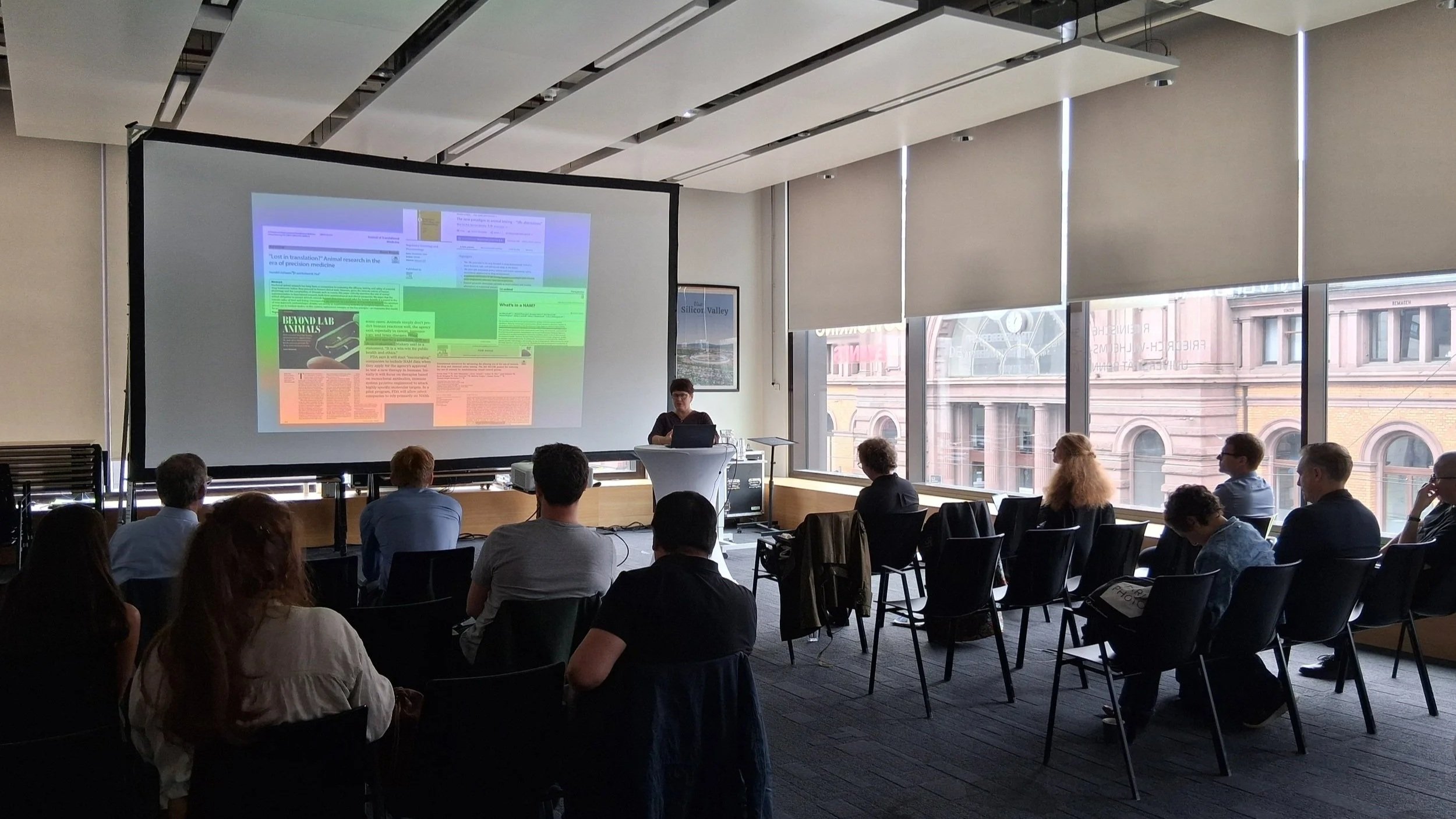
Professor Rachel Ankeny delivering a keynote address talk on New Approach Methodologies while presenting a slide.
To celebrate the start of the collaborative research project NAWiStem3D (Neuronale Organoide: Wissenschaftstheoretische, ethische und rechtliche Implikationen alternativer, aus Stammzellen gewonnener 3D-Modelle) based at the University of Bonn, Prof. Rachel Ankeny (SHAPE network) gave a lecture on “Thinking through NAMs transitions using repertoires” on 8 June 2026. The NAWiStEM3D project investigates the epistemic, ethical, and social questions in connection with three-dimensional models of the brain generated from stem cells, also known as neuronal organoids, and has been funded for three years by the German Federal Ministry of Research, Technology and Space (BMFTR).
Drawing on her concept of repertoires developed jointly with Sabina Leonelli, Rachel’s talk highlighted the need for a more detailed understanding of how NAMs are used across different contexts. A key takeaway was that NAMs transitions will simultaneously involve epistemic, pragmatic, ethical, political, and social processes. Examining the repertoires that underpin different types of research associated with NAMs can help to illuminate important philosophical questions about evidence, responsibility, trust, and decision-making in emerging biomedical technologies and the fields to which they seek to contribute.
Rather than viewing uncertainty as a problem to be eliminated, the discussion suggested that uncertainty can be a positive value: a sign of ongoing change, a realistic acknowledgement of risks, and an invitation to continued scientific and public debate. As NAMs continue to develop, such interdisciplinary perspectives will be essential for shaping responsible and inclusive innovation.